Corporate Welfare Disguised as Progress
Here's who profits from these plants. Here's who breathes the cost.
Industrial Coalition Protests Entergy's Deal
"Entergy should not be allowed to use its monopoly structure to unreasonably impose financial risks on its existing captive ratepayers to serve the new data center load, while it reaps the return-on-equity benefits" — Louisiana Energy Users Group, including Exxon and Dow Chemical
When Exxon and Dow are calling the deal unfair, you know who's getting squeezed. It's not them.
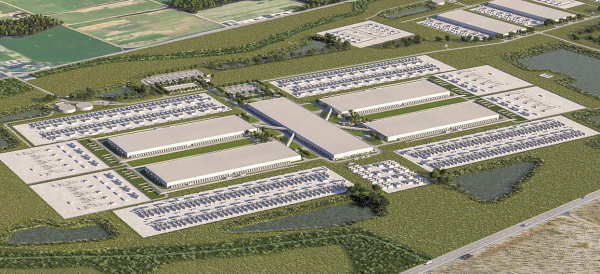
- 2.3 gigawatts of electricity demand
- Equivalent to 2.3 times New Orleans' usage
- Gets subsidized rates for 15 years only
- Ratepayers liable for 30+ year plant costs
Entergy's own permit application never mentions Meta or Richland Parish. The real purpose of these plants is hidden from the official record.
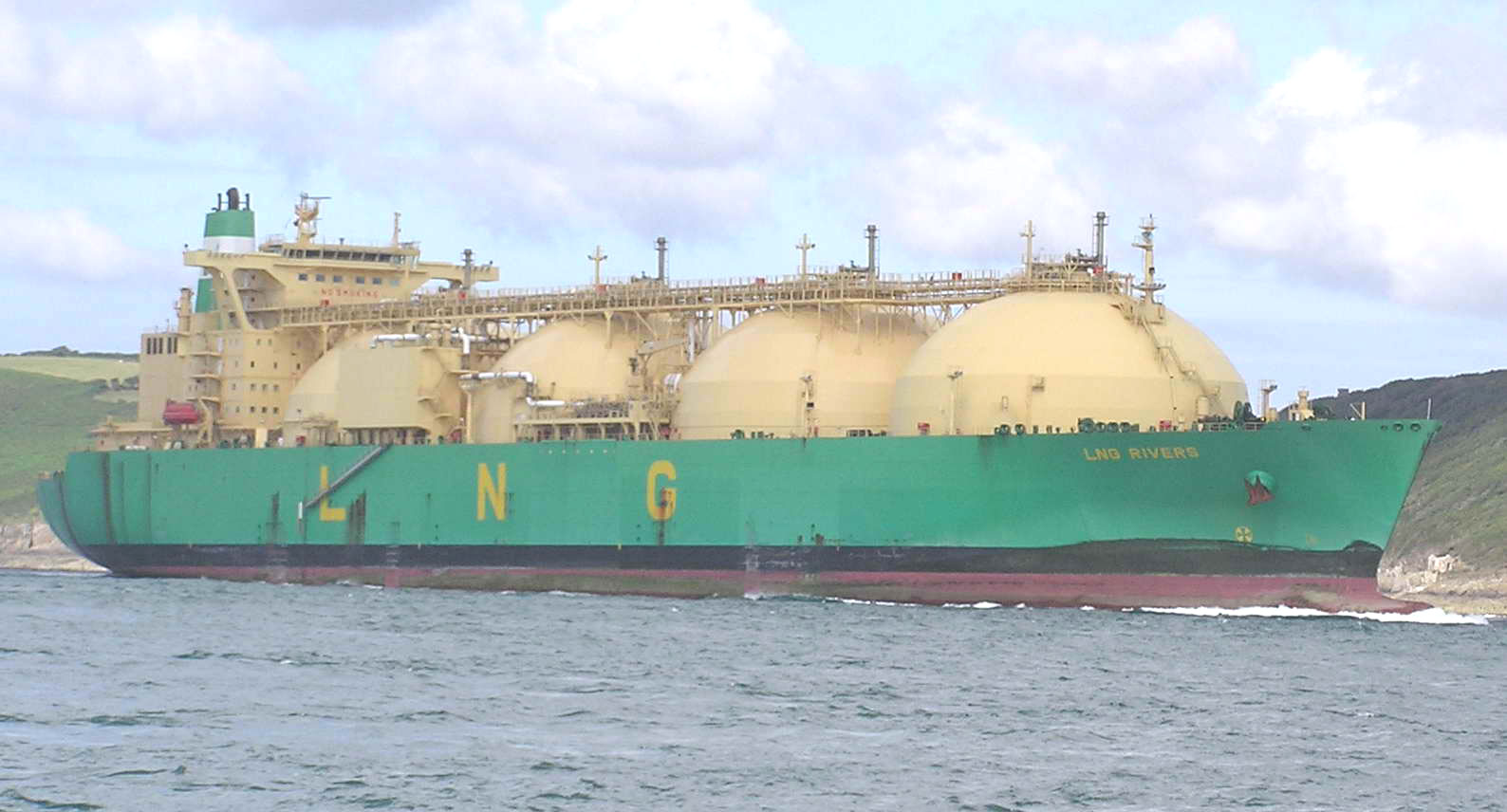
"Higher natural gas prices in 2025 and 2026 are the result of strong export growth that persistently outpaces U.S. natural gas production" — U.S. Energy Information Administration
- Louisiana handles 61% of U.S. LNG exports
- Export demand raises domestic gas prices
- More gas plants = more price volatility for residents
The Rate-Base Expansion Playbook
- $2+ billion in plant costs added to Entergy's "rate base"
- Guaranteed 10–11% annual return on equity for shareholders on approved infrastructure (set by the Louisiana Public Service Commission)
- Meta's contract: 15 years of guaranteed payments covering full system costs
- Ratepayers' liability: 30–40 years of plant costs after Meta's 15-year deal expires
- The gap: ratepayers cover costs Meta doesn't pay, while shareholders pocket the guaranteed return
How this works: The LPSC allows Entergy a 10–11% annual return on equity for capital-intensive infrastructure. On a $2 billion investment with typical utility equity ratios (~40%), that translates to roughly $80–$100 million per year in equity returns — all guaranteed regardless of whether the plants run efficiently or serve customer demand.
"Any costs that Meta doesn't pay will go to the ratepayers. There's no doubt that the benefits are not accruing to the people who are bearing the costs."
— Paul Arbaje, Union of Concerned Scientists
Rushed Through as an "Expedited Permit"
This permit was processed under LAC 33:I.Chapter 18, an expedited track designed for fast-track approval. No competitive alternatives analysis. No renewable energy comparison. No environmental justice review worth the paper it was printed on. Entergy skipped the line. Killona breathes the consequences for 40 years.
The Smoking Gun: Why Build Plants 200+ Miles Away?
Geographic Reality Exposes the Scam
Meta's data center is in Richland Parish, near Monroe. Waterford 5 & 6 will be in St. Charles Parish, near New Orleans. That's over 200 miles apart.
If these plants are really "for" Meta's data center, why are they being built in your backyard? Entergy is already building TWO plants right next to the data center in Richland Parish. Someone else is getting served. You're getting used.
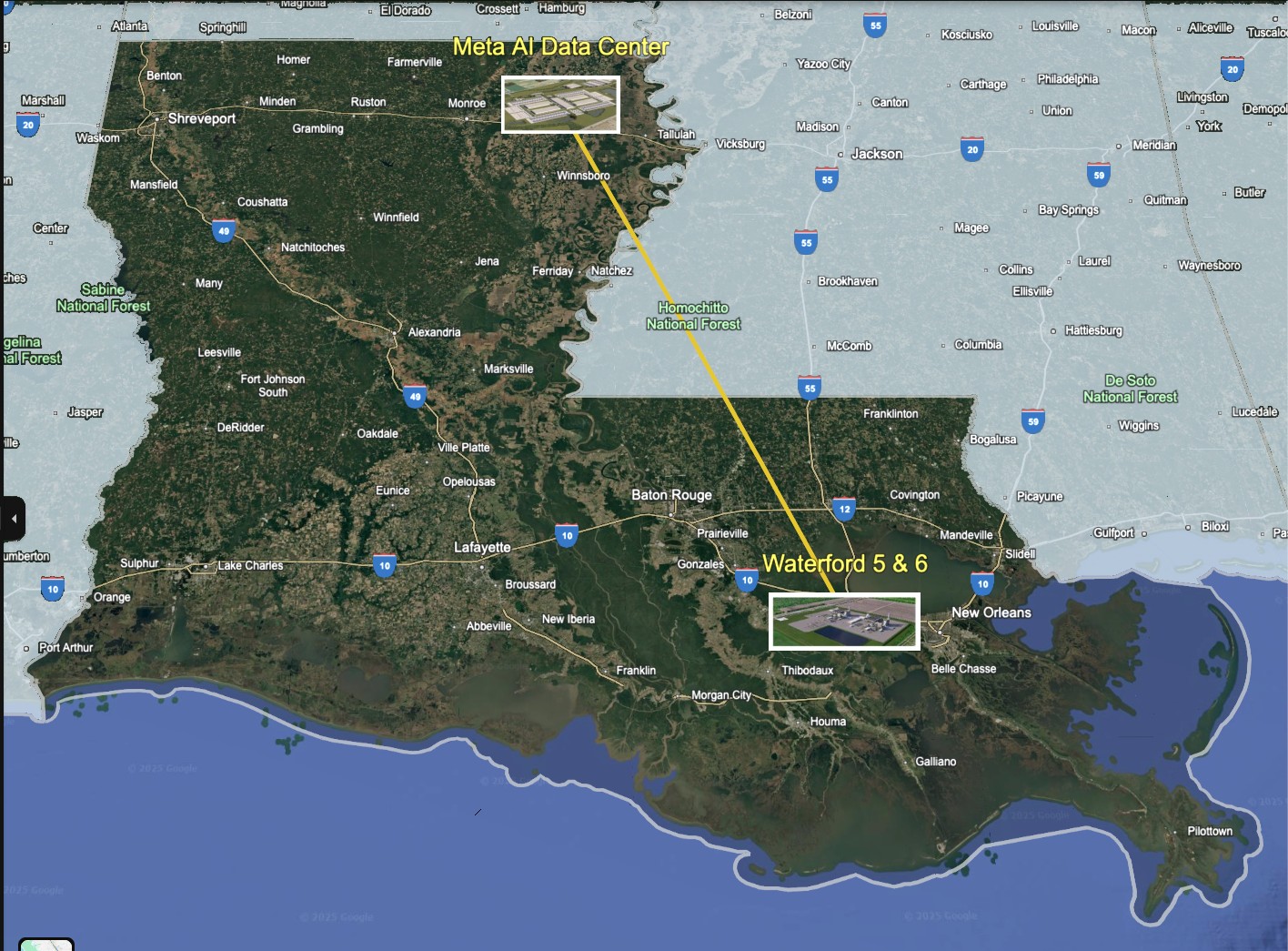
The Engineering Reality:
- 2-4% of electricity is lost in 200 miles of transmission
- Longer lines cost more to build, insure, and maintain
- Grid reliability drops over longer distances
- Engineers build generation near load. Entergy isn't doing that here.
What This Actually Is:
- Rate base expansion sold as public service
- Guaranteed profit baked into every mile of transmission line
- Plants that serve Entergy's balance sheet as much as any data center
- Infrastructure you pay for. Profits Entergy keeps.
Key Fact from Entergy's Own Announcement:
"Build three combined-cycle combustion turbines with a combined capacity of 2,260 megawatts, two of which will be in Richland Parish" — Entergy Louisiana press release
If these plants were truly for Meta, they'd be in Richland Parish. They're not. They're in your community. The data center gets its power. Your family gets the pollution and the rate increases.
Waterford 5 & 6: Built for Meta's Hyperion AI Data Center
Official documents, permit records, and Entergy's own statements tie the Waterford gas build-out directly to Meta's $27-billion Richland Parish AI campus
10 Gas Plants for One Data Center. One of Them Is Being Built in Your Backyard.
Meta is building the world's largest AI data center in Louisiana. To power it, Entergy plans to build 10 new gas-fired power plants totaling roughly 7 to 7.5 gigawatts of capacity across the state, plus nuclear uprates and up to 2.5 GW of solar. Fortune
Entergy's own filings and LPSC docket records show one of the first three Meta-dedicated plants is at the Waterford site in St. Charles Parish. Separate permit records describe new gas units at "Waterford 5 & 6". Multiple independent analyses treat them as part of the same Meta-driven build-out. Entergy
The LPSC approved three combined-cycle gas plants specifically to serve Meta's Richland Parish data center. The docket, U-37425, is titled for "a single customer for a project in North Louisiana." That customer is Meta Platforms.
- Two plants in Richland Parish (Franklin Farms Power Station) — ~1,500 MW, online late 2028
- One plant at the Waterford site in St. Charles Parish — online by end of 2029
- Combined: ~2,262 MW to serve Meta's initial ~2 GW compute load
In March–April 2026, Entergy and Meta disclosed a much larger follow-on agreement adding seven additional gas-fired plants on top of the original three — bringing the total to 10 gas plants, ~7–7.5 GW.
- 7 new plants totaling >5,200 MW additional capacity
- Nuclear power uprates (incl. a 45-MW uprate at Waterford 3, targeted 2029)
- Up to 2,500 MW of renewables (primarily solar)
- ~240 miles of new 500-kV transmission from South to North Louisiana
- More than a 30% increase in Louisiana's total grid capacity
"Build three combined-cycle combustion turbines… two of which will be in Richland Parish and a third at Entergy Louisiana's existing Waterford site in St. Charles Parish."
— Entergy Louisiana press release on LPSC approval
"Two new generating units will be built in Richland Parish and a third facility at the Waterford site, totaling about 2,262 MW."
— Entergy CEO Drew Marsh, Tulane Energy Forum
LDEQ Q1 2026 Construction Stormwater Permits
Louisiana DEQ's early-2026 stormwater permit list includes entries for both "TIC – The Industrial Co – Franklin Farms Power Station" and "TIC – The Industrial Co – Waterford 5 & 6" — receiving construction stormwater coverage in the same permit cycle, consistent with simultaneous site development of the Meta-linked gas projects. LDEQ Q1 2026 PDF
Entergy's Own Blog: "Waterford 5 & 6 Expansion Site"
An April 2026 Entergy corporate blog post describes "Entergy's Waterford 5 & 6 expansion site" and delivery of nearly 100,000 truckloads of soil for soil-surcharging — the foundation for "structures as tall as a 17-story building" — framing it as part of "infrastructure investments supporting major projects like Meta's data center." Entergy blog
Separate LPSC Docket for Waterford 6 & Westlake
A subsequent LPSC filing concerns Entergy Louisiana's application to construct "Waterford 6 Power Station and Westlake Power Station, and for cost recovery" — indicating Waterford 6 is a new CCCT request layered on top of the original 3-plant Meta docket, consistent with the 7-additional-plants expansion. LPSC filing
Independent Trackers Confirm ~1,500 MW Combined
An environmental infrastructure tracker notes Entergy plans two new gas-fired units at Waterford named Waterford 5 and 6, with combined capacity around 1,500 MW, currently in planning/early construction. A project database lists Waterford 6 as a planned 342-MW gas plant in St. Charles Parish. Oil & Gas Watch | Cleanview
Entergy Won't Say It Plainly. The Documents Say It Anyway.
Entergy has never published a press release saying "Waterford 5 and 6 are exclusively for Meta." Here's what official documents do say:
- One new Waterford gas plant is formally named in the 3-plant Meta package per LPSC Docket U-37425 and Entergy's own press releases.
- Waterford 5 & 6 are real, under construction now, likely 1 to 1.5 GW combined, with timing that lines up directly with the Meta generation program.
- Entergy's 10-plant Meta agreement explicitly lists "nuclear power uprates" alongside new gas units — investments that sit squarely on the Waterford site.
- The UCS, Forbes, and most independent analysts count Waterford 5 & 6 as part of the Meta build-out. Entergy just prefers you didn't think about it too hard. UCS | Forbes
What This Permit Allows Into the Air Over Killona
These aren't abstractions. They're what children breathe.
Formaldehyde causes cancer of the nose and throat. LDEQ performed zero cumulative health risk analysis before approving it.
Benzene causes leukemia. This permit releases it into the air above St. Charles Parish homes. No fence-line monitor will tell you when it spikes. You'll just breathe it.
More than some entire countries emit. Every year. Pumped over a community already bearing 200+ petrochemical neighbors in Cancer Alley.
The application just says "no negative EJ impacts" — with nothing behind it. No demographic data. No race or income breakdown. EPA had disabled EJScreen; LDEQ didn't fill the gap.
Formaldehyde. Benzene. Ammonia (653 tons/yr). Sulfuric acid (92 tons/yr). All permitted. No cumulative health risk study was required or performed for people living nearby.
63% of gas plant capacity failed during Winter Storm Elliott. Zero black-start capability is required here. "Grid reliability" is a selling point. It is not a design requirement.
"This form of environmental racism poses serious and disproportionate threats to the enjoyment of several human rights of its largely African American residents, including the right to equality and non-discrimination, the right to life, the right to health, right to an adequate standard of living and cultural rights"
— UN Human Rights Experts on Louisiana's Cancer Alley
St. Charles Parish communities already breathe more industrial pollution than almost anywhere in America. Entergy's permit application contains no demographic data, no race or income analysis, no comparison to state or national averages. Adding 5 million tons of CO₂ and cancer-causing chemicals to Cancer Alley and writing "de minimis" on the form is environmental racism with a rubber stamp on it.
The "Carbon Capture" Promise Is a Fiction
The permit commits to stricter CO₂ limits after 2032, contingent on carbon capture technology. The problem: Entergy's own record concedes there are no Class 6 carbon sequestration wells near the site. The promise was made to get the permit signed. The technology to keep it doesn't exist nearby. Killona breathes the full emissions in the meantime. For decades.
What Experts and Advocates Are Saying
Real concerns from regulators, scientists, and community leaders
"Any costs that Meta doesn't pay will go to the ratepayers. There's no doubt that the benefits are not accruing to the people who are bearing the costs."

Paul Arbaje
Union of Concerned Scientists
"I believe my most important job as a regulator is to trust but verify and the truth is, there were a lot of things that I just cannot verify at this moment. The fundamentals at the heart of this proposal were just too bitter for me to swallow."

Commissioner Davante Lewis
Louisiana PSC (Dissenting Vote)
"Our community is surrounded by industrial facilities sucking the life out of us daily with excessive cancer causing pollution. These pollutants have affected our health causing lung, prostate, liver, pancreas, and breast cancer."
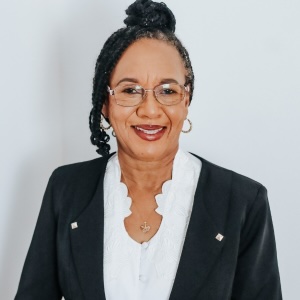
Barbara Washington
Inclusive Louisiana
"We're dying from inhaling the industries' pollution. I feel like it's a death sentence. Like we are getting cremated, but not getting burnt."
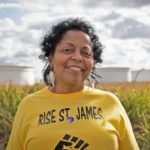
Sharon Lavigne
Rise St. James, Goldman Prize Winner
"The push to force through approval of the Meta proposal is illustrative of our greatest concern – that corporate utilities believe the Louisiana Public Service Commission answers first and foremost to them, not Louisiana ratepayers."

Logan Atkinson Burke
Alliance for Affordable Energy
"Entergy can't keep the lights on on a good day."

Logan Wolfe
Earthworks